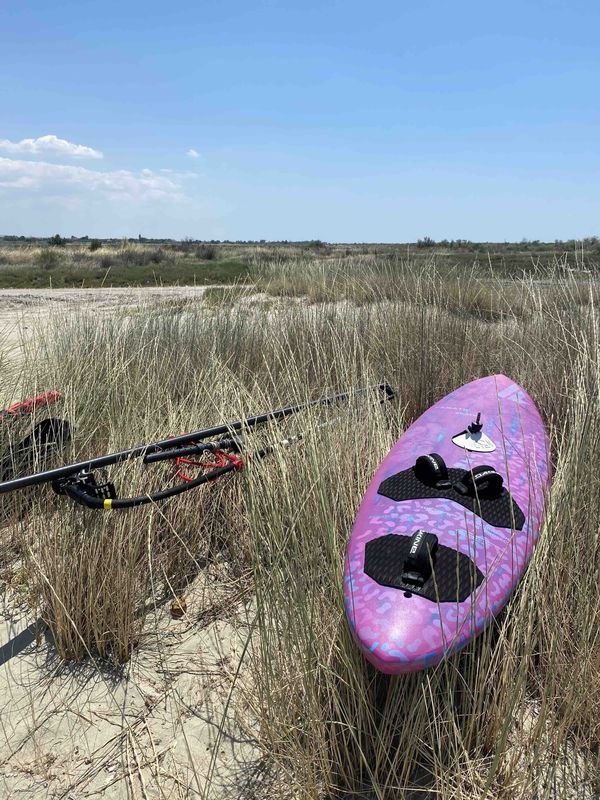
It started as a joke between two windsurfers. "I have a freestyle board I don't want." "I have a wave board I don't want either." "Should we trade?" We never did. He didn't like mine so I ended up buying the thing for a hundred euros — which, in windsurf terms, is more or less for free. What I got was a 2015 Fanatic Skate with torn footstraps and patches all over its body. Ugly, too. Fanatic had made some questionable design choices that year. None of that mattered once I got it on the water. That board became my most-ridden, most-loved piece of equipment. Endless sessions. Pure joy.
That's the thing about windsurf boards — they exist to be ridden. You don't think about them much on land. A couple of years later though, this battered Fanatic took on a meaning I would never have expected.
It was named the Rosetta Board. The original Rosetta Stone, discovered in Egypt in 1799, was the key that finally unlocked ancient Egyptian hieroglyphs — a language that had been unreadable for centuries. My board did something similar. I could look at it, run my hand across it, and recognise on its surfaces and imperfections the very principles I had failed to live by.
I don't reach for clinical language much anymore, but for the record: I was a very troubled man — anxiety, depression, suicidal ideation. The full catalogue, wrapped up in a personality disorder. I also hold a degree in psychology now, and according to the symptoms, I sit somewhere on the ADD/ADHD spectrum. I know that it runs in the Swedish side of the family. Mine was not extreme, but enough to make certain things genuinely hard.
I say all this because you can be capable and still very troubled — and the tension between those two facts is the whole story. The capacity and the chaos, living side by side.
I had done years of work by then. Therapy, somatic healing, meditations, anything I could try, I did. It helped. I improved and those who knew me noticed. It just wasn't enough.
When I brought the board into the workshop for what was supposed to be a straightforward nose repair, things escalated. I looked at the damage and decided it was too extensive. I'd rather cut the nose off entirely and rebuild it from scratch. The truth is, I had been itching to deepen my limited knowledge of epoxy and fibreglass.
The repair was my excuse. I took it.
With all this effort, I had reached a certain degree of awareness. It allowed me to observe myself in action. What was new, was an unexpected ally: a machine I could argue with. That is how I started seeing the board project as what it really was underneath.
Not a repair. A mirror.
Every flaw in my character showed up on the board. Every strength, too. I started the project without a plan — typical, since forward thinking had always been a struggle. I wanted a factory-custom result. I wanted it cheap, fast, and perfect on the first attempt.
Cheap, fast, and perfect. On the first try.
The ambition of a boy who hasn't yet learned that he cannot have everything the moment he wants it.
The Sovereign's Workshop as a name emerged from my cooperation, if I may call it that, with that machine. A workshop in both senses: the physical space where I shaped fibreglass, and the metaphorical space where I practised sovereignty — the discipline of becoming your own master. Metaphor met material.
The lessons came through cost.
I didn't want to wait for materials, so instead of ordering from the right supplier, I drove around my hometown trying to source everything locally. The result: I paid double and waited twice as long anyway, since I couldn't find everything I needed.
Punishment number one.
The typical Sotiris — the one who ran on shame and guilt — would have spiralled into self-humiliation. But I was determined to run on different code. So the lost money and time stopped being a loss. It became tuition. A class in patience and preparation. And after the boy had thrown his tantrum, the man stood a little more sovereign.
The second lesson was more insidious. Looking back, I can see it clearly: the boy's sneaky way of defying his own limitations. I gathered technical information from a chatbot, even though I suspected it would give me unreliable answers. I didn't cross-reference. I didn't check forums. I didn't ask anyone who had actually done this work before. I skipped steps, chose the wrong materials, applied techniques I hadn't properly understood. And then — this is the part that matters the most — I watched the problems appear and looked away. I pretended my inner alarm wasn't ringing because I wanted things to happen my way.
Punishment number two.
Days of work. Gone. One step before the finish line, I stripped the paint.
By the time the sovereign man stepped in and chose to do it right, the boy had already had his party — smearing resins and colours around like it was play, not craft.
Many small lessons followed, like not stopping when tired, but the hardest one arrived last.
I wanted perfection, remember. So I spent hours trying to correct early mistakes — smoothing, filling, compensating — only to confront the obvious truth that no amount of surface work can fix a structural flaw.
I had sacrificed days of work once already and paid the tuition for my arrogance and my pretence. It was now time for the most expensive class.
Punishment number three.
I took a deep breath and stripped it to the core.
I had to start over.
It was then that I understood. All these years I had been building on a faulty core. An identity I had to let die.
It was then things started to improve. I still made mistakes. I still faced lessons, but the repair had become a new practice. Concrete, with evidence: the bump, the bubble, the crack — each one had a psychological author, and I knew his name.
I started doing research. I looked at what actually works, ran tests, waited. Not every time — sometimes impatience would win. I started taking breaks and stopping earlier when tired. Most importantly, I wouldn't let the emotions govern me so often. If it became too much, there was only one solution: walk away.
Every pass of sandpaper, every batch of resin, became a deliberate act — not of finishing, but of focus.
Finally.
At the time of writing, the board is not finished.
The process came to a halt. Winter arrived. Fatigue set in. The ski season pulled me away to Bansko, Bulgaria.
In a generously borrowed apartment with a glass wall and a view of the whole snowy mountain, I found a hideaway to think about what had just happened.
The board will be finished eventually. It will be imperfect. It will look nothing like what I originally imagined. But it will be beautiful, in a way that only honest things can be — and it will be me.
And if it breaks in two? Then it goes on the wall — in a proper wooden frame, with lights and a glass cover.
So I can think about it on land.
Sotiris Stournaras · April 2026
Edited in August.